by Jimmie Fair
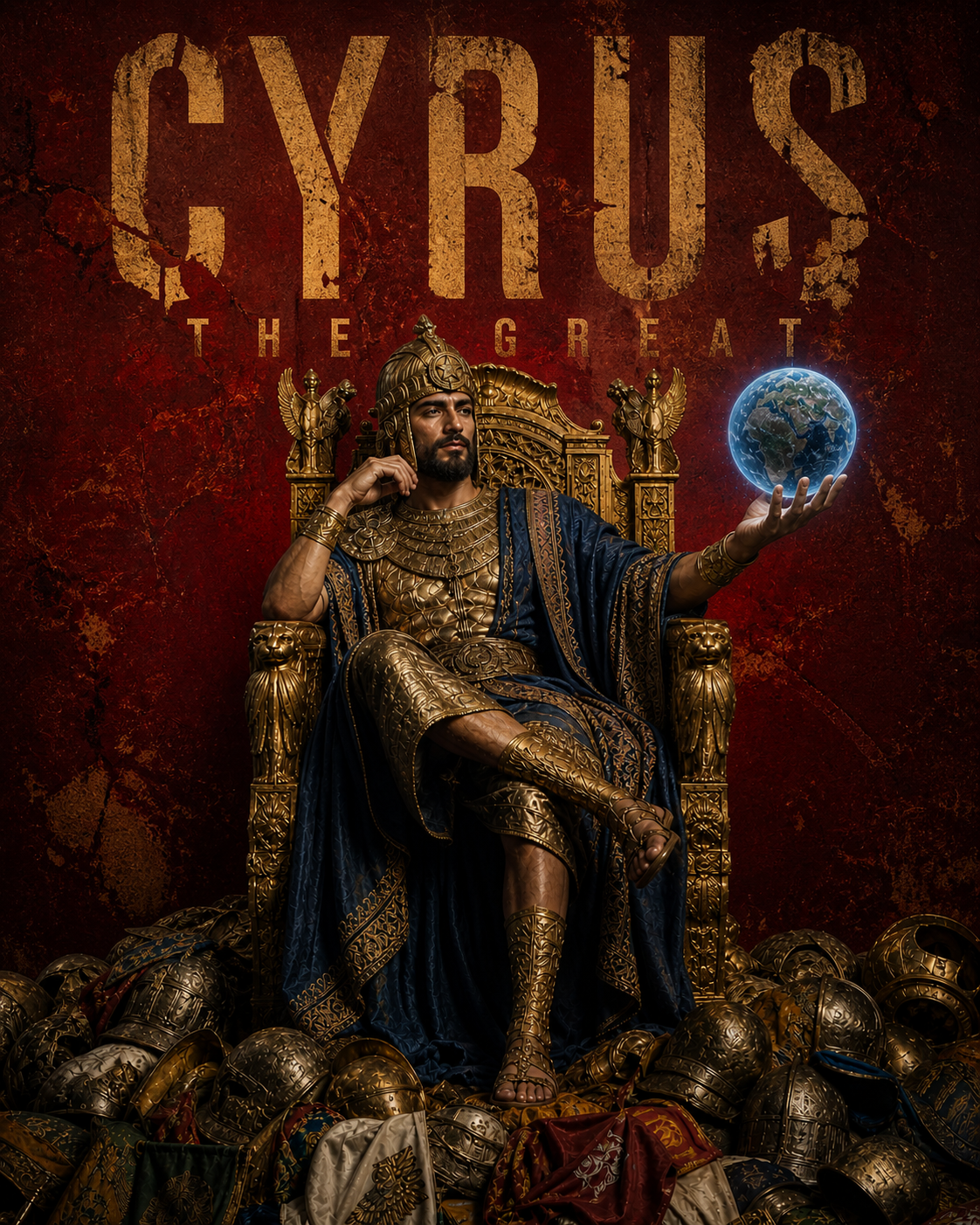
History doesn’t remember men kindly. It reduces them, flattens them, turns flesh into footnotes and myth into marble. But every once in a while, a figure breaks through that erosion. A man who doesn’t just shape events, but rewrites the rules by which power itself is understood. Cyrus II of Persia—known to history as Cyrus the Great—is one of those men. Not because he conquered, but because of how he conquered. Not because he ruled, but because of how he chose to rule.
We begin in a world that predates what we now call “civilization” in its modern sense. The 6th century BCE Near East was not a unified political landscape but a mosaic of competing powers—Media, Lydia, Babylon—each convinced of its permanence, each unaware that history was already sharpening its blade. Into this fractured order stepped Cyrus, born into the Achaemenid lineage, a minor Persian dynasty under Median dominance (Briant, 2002). His early life, filtered through both legend and fragmentary record, carries the familiar shape of destiny: a child marked by prophecy, spared from death, raised with an awareness—if not certainty—of purpose (Herodotus, trans. 2008).
But strip away the myth, and what remains is more dangerous: a strategist.
Cyrus’ first major act was not conquest, but rebellion. Around 550 BCE, he rose against the Medes, overthrowing his grandfather Astyages and absorbing the Median kingdom into what would become the Persian Empire (Kuhrt, 2007). This was not simply a transfer of power; it was a transformation of identity. Cyrus did not erase the Medes. He incorporated them. Their elites were not executed but absorbed into his administration. Their culture was not destroyed but layered into his own. It was the first signal of something new—an empire not built purely on fear, but on calculated inclusion.
Modern readers like to romanticize this as benevolence. It wasn’t. It was smarter than that.
Cyrus understood something that too many rulers before and after him did not: terror controls people in the short term; legitimacy controls them in the long term. By positioning himself as a liberator rather than a conqueror, Cyrus rewrote the psychological contract between ruler and ruled (Briant, 2002). He wasn’t just taking land—he was taking loyalty.
His campaign against Lydia, culminating in the defeat of King Croesus around 546 BCE, demonstrates this duality of force and restraint. Lydia was wealthy, militarily competent, and strategically significant. Cyrus defeated it decisively. But again, he did not reduce it to ashes. Croesus himself, according to some accounts, was spared and even retained as an advisor (Herodotus, trans. 2008). Whether embellished or not, the narrative persists because it aligns with the broader pattern of Cyrus’ rule: conquest followed by integration.
Then came Babylon.
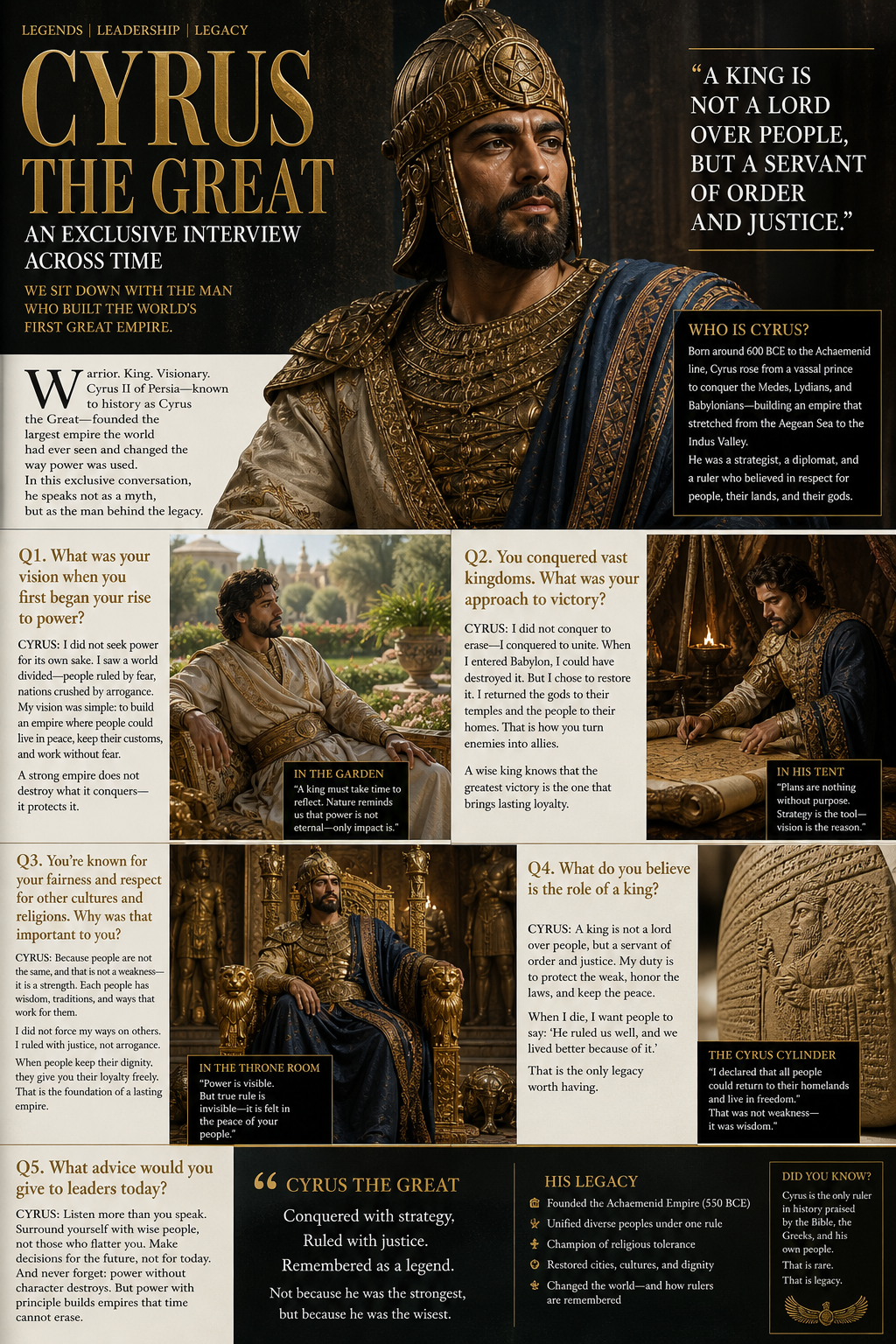
If Cyrus’ earlier campaigns built his reputation, the fall of Babylon in 539 BCE cemented his legacy. Babylon was not just another city. It was the cultural and political center of the ancient Near East, layered with centuries of imperial authority. Taking Babylon was not just a military victory; it was a symbolic act of succession.
And Cyrus didn’t storm it like a brute.
Instead, he entered Babylon with minimal resistance, leveraging internal dissatisfaction with the ruling king Nabonidus and presenting himself as a restorer of order (Kuhrt, 2007). The city opened to him. No widespread destruction. No massacre. Just a transition of power so smooth it almost felt staged.
This is where the Cyrus Cylinder enters the conversation.
Often called the first declaration of human rights—a label historians argue over with the kind of passion usually reserved for sports debates—the Cylinder records Cyrus’ policies after the conquest of Babylon (British Museum, n.d.). It describes his efforts to return displaced peoples to their homelands and restore their religious practices. Among these were the Jews exiled to Babylon, whose return to Jerusalem is recorded in biblical texts (Ezra 1:1–4, New Revised Standard Version).
Now, let’s not get carried away. Cyrus was not drafting a constitution for universal freedom. He was stabilizing a newly acquired empire. But intent doesn’t erase impact. His policies created a framework in which diverse cultures could exist under a single political structure without constant rebellion. That matters.
It matters because it worked.
At its height, the Achaemenid Empire stretched from the Aegean Sea to the Indus Valley, from Central Asia to Egypt (Briant, 2002). This wasn’t just large. It was unprecedented. And it held—not because Cyrus crushed every difference, but because he managed them.
Think about that in modern terms. Nations today struggle to govern populations far smaller and more homogeneous than what Cyrus controlled. And yet, in the 6th century BCE, without modern communication, without centralized bureaucracies as we understand them, he built something that endured beyond his lifetime.
That doesn’t happen by accident.
Cyrus’ leadership style was not rooted in ideology but in adaptability. He took what worked from each culture he encountered and folded it into his system. Administrative practices from the Medes. Economic structures from Lydia. Religious tolerance policies reinforced in Babylon. It was less a fixed model and more a living organism—evolving, adjusting, expanding.
And yet, for all his calculated brilliance, there is still the matter of myth.
The image of Cyrus as the “great” is not solely a product of Persian propaganda. Greek historians, who were not exactly known for flattering foreign rulers, acknowledged his capabilities (Xenophon, trans. 1998). Biblical texts frame him as divinely chosen. Even later Roman writers reference him as a model of kingship.
That kind of cross-cultural admiration doesn’t happen easily.
But admiration should not blind us.
Cyrus was still an imperialist. His empire was built through war, through the subjugation of territories that did not choose him. The difference lies in how he treated victory. Where others saw domination as the end goal, Cyrus treated it as the beginning of governance.
There’s a lesson in that, whether people want to admit it or not.
Power is not proven by how loudly you can take something. It’s proven by how long you can keep it without everything collapsing under you.
Cyrus understood that before most.
His death, like his life, sits somewhere between record and legend. According to Herodotus, he died in battle against the Massagetae, a nomadic people led by Queen Tomyris (Herodotus, trans. 2008). The story ends violently, with Tomyris supposedly placing his severed head in a container of blood, declaring that he had finally had his fill of it. Whether true or not, the symbolism is sharp: even the greatest empire builder is still subject to the same mortality as the rest.
And yet, Cyrus’ empire did not collapse with him.
That might be the most important point of all.
Too many rulers build systems that depend entirely on their presence. Remove them, and everything falls apart. Cyrus built something that could continue. His successors—Cambyses, Darius—expanded and refined what he started. The structure held.
That’s not luck. That’s design.
So where does that leave us, sitting here centuries later, looking back?
It leaves us with a figure who refuses to fit neatly into modern categories. He was not a democrat. Not a humanitarian in the modern sense. Not a tyrant in the simplistic way history sometimes prefers. He was something more complex—and more useful to study.
Cyrus represents a form of leadership that blends force with foresight, ambition with restraint. He shows that empires are not sustained by dominance alone, but by the ability to make those within them see a future under your rule.
That’s uncomfortable, because it suggests that power, when used strategically, can be stabilizing rather than purely destructive.
And that doesn’t sit well in a world that prefers clear villains.
But history doesn’t care about our preferences.
It records what works.
And what worked, for Cyrus, was an understanding that ruling people is not the same as owning them.
He didn’t just take the world.
He convinced it—at least for a time—to stay in his hand.
References (APA Style)
Briant, P. (2002). From Cyrus to Alexander: A history of the Persian Empire. Eisenbrauns.
British Museum. (n.d.). The Cyrus Cylinder. https://www.britishmuseum.org
Curtis, J., & Tallis, N. (2005). Forgotten empire: The world of ancient Persia. British Museum Press.
Dandamaev, M. A. (1989). A political history of the Achaemenid Empire. Brill.
Dusinberre, E. R. M. (2013). Empire, authority, and autonomy in Achaemenid Anatolia. Cambridge University Press.
Ezra 1:1–4. (NRSV).
Herodotus. (2008). The Histories (R. Waterfield, Trans.). Oxford University Press.
Kuhrt, A. (2007). The Persian Empire: A corpus of sources from the Achaemenid period. Routledge.
Olmstead, A. T. (1948). History of the Persian Empire. University of Chicago Press.
Root, M. C. (1979). The king and kingship in Achaemenid art. Brill.
Schmitt, R. (2011). The Bisitun inscriptions of Darius the Great. Oxford University Press.
Stronach, D. (1997). Pasargadae: A report on the excavations conducted by the British Institute of Persian Studies. Oxford University Press.
Waters, M. (2014). Ancient Persia: A concise history of the Achaemenid Empire. Cambridge University Press.
Xenophon. (1998). Cyropaedia (W. Miller, Trans.). Harvard University Press.
Allen, L. (2005). The Persian Empire. University of Chicago Press.
Amélie Kuhrt (Ed.). (2013). The Persian Empire: A historical encyclopedia. ABC-CLIO.
Brosius, M. (2006). The Persians: An introduction. Routledge.
Cook, J. M. (1983). The Persian Empire. Schocken Books.
Frye, R. N. (1984). The history of ancient Iran. C.H. Beck.
Lincoln, B. (2007). Religion, empire, and torture. University of Chicago Press.
Sancisi-Weerdenburg, H. (1987). Achaemenid history. Netherlands Institute for the Near East.
Bickerman, E. J. (1980). The Jews in the Greek age. Harvard University Press.
Grabbe, L. L. (2004). A history of the Jews and Judaism in the Second Temple period. T&T Clark.
Kent, R. G. (1953). Old Persian: Grammar, texts, lexicon. American Oriental Society.
Boyce, M. (1982). Zoroastrians: Their religious beliefs and practices. Routledge.
 The Fair Response
Leave a comment