A Confidential-Style Briefing on Iran, the Strait of Hormuz, and the Long War Nobody Should Want
Mr. President, the matter before us is not simply “America versus Iran,” because history has a nasty habit of laughing at simple explanations. The issue is the Persian Gulf, the Strait of Hormuz, energy security, U.S. credibility, Israeli security, Iranian regime survival, global oil prices, domestic politics, and the possibility that one narrow waterway can make the whole world remember that geography still bullies everybody. The Strait of Hormuz is the pressure point: a narrow passage between Iran and Oman, roughly 30 miles wide at its narrowest point, connecting the Persian Gulf to the Gulf of Oman and then to the Arabian Sea. That small strip of water carried about 20 million barrels per day of oil in 2024, equal to about 20% of global petroleum liquids consumption, and about one-fifth of global liquefied natural gas trade also moved through it, primarily from Qatar. In plain language, if Hormuz coughs, gas prices sneeze in Atlanta.
The American point of view is built around four core interests: preventing Iran from obtaining or expanding nuclear weapons capability, protecting U.S. forces and citizens, defending freedom of navigation through international waters, and preserving regional partners including Israel, Saudi Arabia, the United Arab Emirates, Qatar, Bahrain, and Kuwait. That last list matters because U.S. interests in the region are not theoretical. They are bases, ships, energy routes, intelligence partnerships, air defense networks, and American personnel sitting inside missile range because apparently global leadership comes with the gift basket of permanent exposure. Current reporting says tensions have escalated around “Project Freedom,” a U.S. effort to help commercial vessels move through or near the Strait, while Iran has warned that ships moving through the area must coordinate with its forces and has claimed to block U.S. naval movement, claims the U.S. has partly denied where Iran alleged missile strikes.
Historically, the U.S. has faced Iran through sanctions, covert pressure, diplomacy, maritime protection, cyber operations, and limited military strikes rather than full invasion. The modern conflict traces back through the 1979 Iranian Revolution, the hostage crisis, the Iran-Iraq War, U.S. reflagging of Kuwaiti tankers during the “Tanker War,” the 1988 U.S. naval clash with Iran in Operation Praying Mantis, the long nuclear dispute, the 2015 nuclear agreement, the U.S. withdrawal from that agreement in 2018, and the repeated cycle of sanctions and retaliation since. A 2025 Congressional Research Service brief notes that Congress was reviewing the June 2025 U.S. military strike against Iran’s nuclear program, which administration officials said was intended to “destroy or severely degrade Iran’s nuclear program.” That phrase matters because it reveals the American strategic preference: degrade capability without owning the country. Very Washington, really. Break the machine, avoid buying the factory.
The geography favors trouble. Iran does not need to defeat the U.S. Navy to impose cost. It can use mines, drones, fast attack boats, anti-ship missiles, cyber disruption, proxies, and harassment tactics to make shipping companies decide the route is too risky. The U.S. Navy can dominate open water, but Hormuz is not open water. It is a chokepoint. U.S. Naval Institute analysis has compared any sustained fight to control Hormuz with the historical lesson of Gallipoli: narrow waterways punish overconfidence, and clearing them under fire is ugly, slow work. Another USNI article warns that any conflict with Iran must account for mine countermeasures because mining the strait is one of Tehran’s most potent asymmetric levers. Translation: America may have the bigger hammer, but Iran does not need a bigger hammer. It just needs nails in the road.
Can America win militarily? Yes, if “win” means destroying Iranian naval assets, suppressing coastal missile systems, reopening shipping lanes temporarily, and punishing Iranian military infrastructure. No, if “win” means occupying Iran, pacifying the country, eliminating all proxy retaliation, and creating a stable pro-American regional order. That second definition is where empires go to get humbled. Iran is mountainous, large, nationalistic, and politically complex. It is not Iraq 2003, and it is definitely not a weekend project for people with nice maps and bad memories. Ground troops inside Iran would face terrain, weather, nationalism, urban resistance, long logistics, and escalation risk. The smarter military posture would likely remain naval, air, cyber, special operations, missile defense, intelligence sharing, and limited strikes, not mass occupation. A full ground war would risk becoming less like a clean campaign and more like Vietnam, Iraq, and Afghanistan decided to form a trauma committee.
The weather and operating environment matter. The Gulf region is brutally hot for much of the year, with summer temperatures that can degrade equipment, increase water and medical demands, and make sustained ground operations miserable. Dust, humidity, and maritime heat complicate maintenance and readiness. On the water, the Strait’s narrow traffic lanes, proximity to Iranian territory, and civilian shipping density increase the chance of miscalculation. The more crowded the chessboard, the easier it is for somebody to knock over the table and claim strategy.
The cost would depend on scale. A limited maritime protection mission with air and naval assets could cost billions over months, especially if it includes carrier strike groups, destroyers, minesweepers, missile defense, tanker support, intelligence platforms, and emergency shipping insurance support. A wider regional war could run into tens or hundreds of billions, not including oil shock effects. UNCTAD reported in March 2026 that disruptions in Hormuz had already pushed Brent crude above $90 per barrel, showing how quickly energy markets respond when the strait becomes unstable. The domestic effect could be immediate: higher gasoline prices, higher shipping costs, inflation pressure, consumer anger, airline fuel costs, and political pressure before elections. Nothing reminds voters of foreign policy like paying more at the pump.
The 6-to-12-month play breaks into four scenarios. The best case is managed de-escalation: Pakistan, Oman, Qatar, or European intermediaries help produce a maritime arrangement that allows ships to move, Iran gets limited sanctions relief or humanitarian channels, and nuclear talks are separated from immediate navigation issues. The middle case is a long gray-zone standoff: U.S.-protected shipping moves intermittently, Iran harasses vessels indirectly, oil prices stay elevated, and both sides claim victory while everyone else pays extra. The bad case is a major naval incident: a U.S. vessel, allied ship, or commercial tanker is hit, forcing retaliation and opening a broader air-sea campaign. The worst case is regional cascade: Iran’s proxies escalate against U.S. interests, Israel strikes deeper, Gulf states face missile threats, and American domestic security agencies shift into heightened alert.
Inside the United States, the risk should be discussed carefully. I will not list specific soft targets or provide a menu of attack locations, because that would be irresponsible and, frankly, stupid in a way even history books would underline. The proper framing is broader: U.S. agencies would likely heighten monitoring around critical infrastructure, diplomatic sites, Jewish and Israeli-linked institutions, transportation systems, cyber networks, military-adjacent facilities, energy infrastructure, and high-profile public events. The main concern would not necessarily be a centrally directed “sleeper cell” in the movie sense. It could include lone actors, online-inspired extremists, cyber retaliation, proxy-linked facilitation, or vandalism and intimidation tied to the conflict. The FBI and DHS posture would likely focus on threat reporting, suspicious activity monitoring, cyber defense, and community protection without turning fear into policy. Fear is useful as an alarm. It is useless as a steering wheel.
Long term, a war with Iran would strain American interests. It could push Iran closer to Russia and China, harden Tehran’s nuclear incentives, destabilize Iraq and Syria, threaten Gulf monarchies, endanger U.S. troops, and make Asian energy buyers nervous. The International Energy Agency notes that in 2025 nearly 15 million barrels per day of crude, about 34% of global crude oil trade, passed through the Strait of Hormuz, with China and India receiving a large share. That means this is not only America’s problem. It is a global trade problem, and Washington should force burden-sharing from Asian and European partners rather than letting the U.S. taxpayer play world security guard while everyone else sends thoughtful statements.
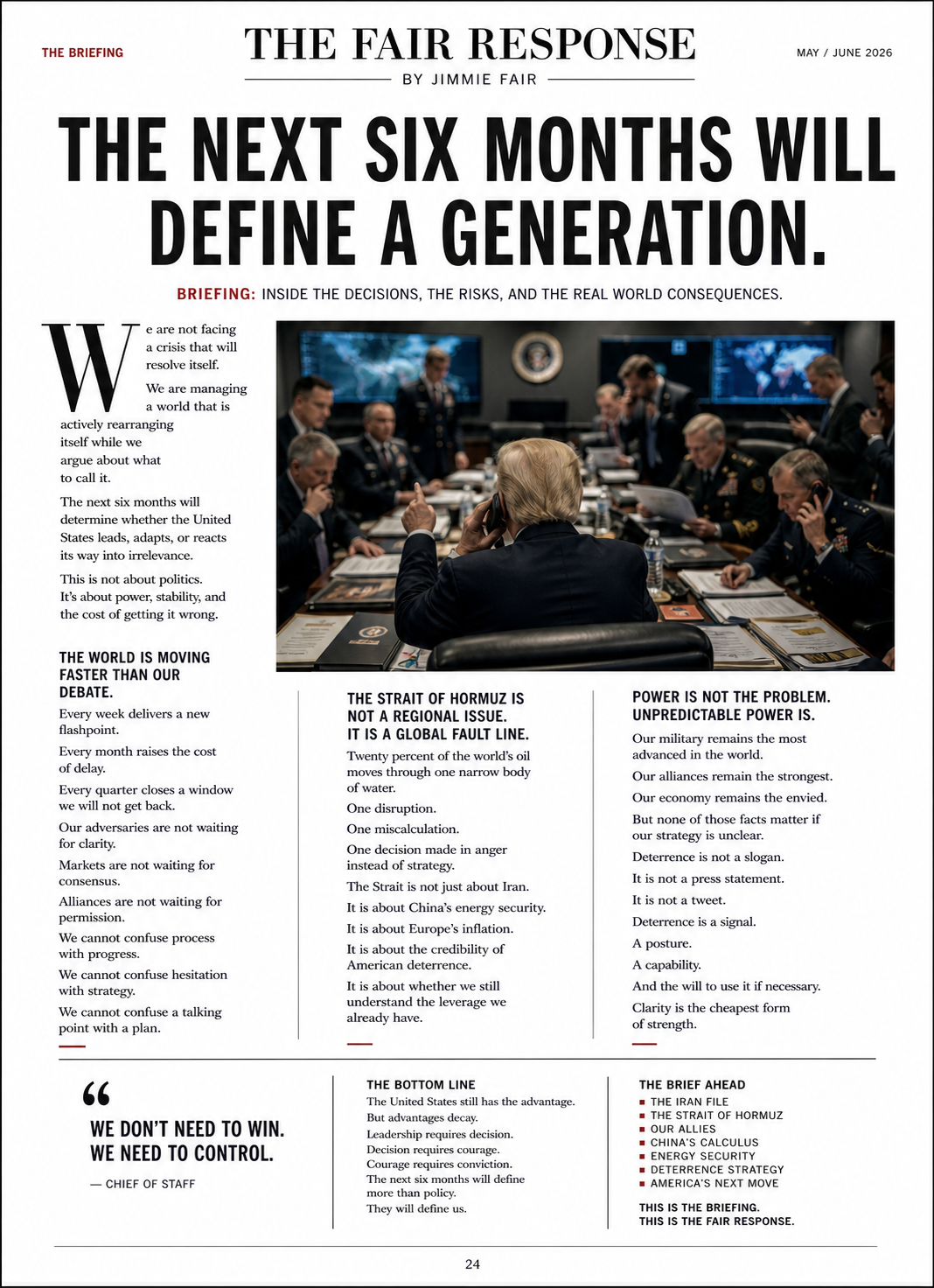
The recommendation is disciplined pressure, not emotional escalation. Maintain naval presence, protect shipping through coordinated multinational routes where possible, accelerate mine countermeasure capacity, harden Gulf bases, expand cyber defense, keep backchannel diplomacy open, and define red lines publicly but narrowly. Avoid ground invasion. Avoid regime-change language unless prepared for the consequences. Keep Congress briefed, because war powers fights at home during escalation abroad are how governments trip over their own shoelaces. Push allies to contribute ships, intelligence, and funding. Use sanctions as leverage, not as a religion. Leave Tehran a door it can walk through without pretending it won.
This is not another Vietnam unless America decides to make it one. A limited maritime and air campaign can achieve limited objectives. A ground war to remake Iran would be strategic malpractice wearing a flag pin. The United States can hurt Iran badly. It can reopen Hormuz temporarily. It can defend partners. But “winning” must be defined before the shooting starts. If the mission is freedom of navigation, keep it there. If the mission becomes regime collapse, nuclear rollback, proxy destruction, and domestic transformation, congratulations, we have bought another forever war with better graphics and worse gas prices.
References
Congressional Research Service. (2025). Counterproliferation in U.S. policy.
International Energy Agency. (2025). Strait of Hormuz.
Reuters. (2026, May 4). Iran prevents entry of U.S. warships into Strait of Hormuz, Navy says.
The Associated Press. (2026, May 4). U.S. says two American-flagged merchant vessels have transited the Strait of Hormuz.
The Guardian. (2026, May 4). Iran says ships being “guided” by U.S. through Hormuz must work with its armed forces.
U.S. Energy Information Administration. (2025). Amid regional conflict, the Strait of Hormuz remains critical to global oil flows.
U.S. Energy Information Administration. (2025). About one-fifth of global liquefied natural gas trade flows through Strait of Hormuz.
U.S. Naval Institute. (2026). The Battle of Gallipoli’s sobering lessons for the Strait of Hormuz.
U.S. Naval Institute. (2026). The crisis in mine countermeasures.
UNCTAD. (2026). Strait of Hormuz disruptions: Implications for global trade and development.
 The Fair Response
Leave a comment