by Jimmie Fair
The Supreme Court’s recent decision in Louisiana v. Callais has reopened one of the most explosive questions in American election law: when does race-conscious redistricting protect minority voters, and when does it become an unconstitutional racial gerrymander? The Court struck down Louisiana’s congressional map that created a second majority-Black district, holding that the Voting Rights Act did not require Louisiana to draw that district and therefore could not justify the state’s use of race in that way. SCOTUSblog summarizes the holding this way: “Because the Voting Rights Act of 1965 did not require Louisiana to create an additional majority-minority district, no compelling interest justified the state’s use of race in creating SB8, and that map is an unconstitutional racial gerrymander.”
That ruling matters in Georgia because Georgia’s 2023 court-ordered redraw was built around the same legal tension: Section 2 of the Voting Rights Act, Black voting strength, and how far lawmakers may go in drawing districts that consider race without making race the controlling factor. Section 2 says no state may use any voting rule or districting practice that “results in a denial or abridgement” of the right to vote on account of race or color. In plain English, that means a map can violate federal law even if no one admits racist intent, if its actual effect weakens minority voters’ ability to elect candidates of their choice.
The legal headache, because apparently democracy needed a Rubik’s Cube with lawyers, is that courts have long allowed some consideration of race to comply with Section 2, but the Equal Protection Clause of the Fourteenth Amendment forbids race from “predominating” unless the state can satisfy strict scrutiny. That means the state must prove a compelling interest and narrow tailoring. In classroom language: race can be part of the recipe, but if it becomes the whole meal, the Court may throw it out.
Georgia is vulnerable to this debate because its recent redistricting fight centered on Black voter growth in metro Atlanta and whether lawmakers should have drawn more majority-Black or Black-opportunity districts. In 2023, U.S. District Judge Steve Jones struck down Georgia’s congressional and legislative maps after finding they diluted Black voting power, and Georgia lawmakers returned in special session to redraw them. The revised maps added majority-Black districts but preserved Republican advantages, including a 9–5 Republican edge in the U.S. House delegation. The Associated Press reported that the accepted maps “protect Republican partisan advantages,” while also satisfying the court’s order to remedy illegal minority vote dilution.
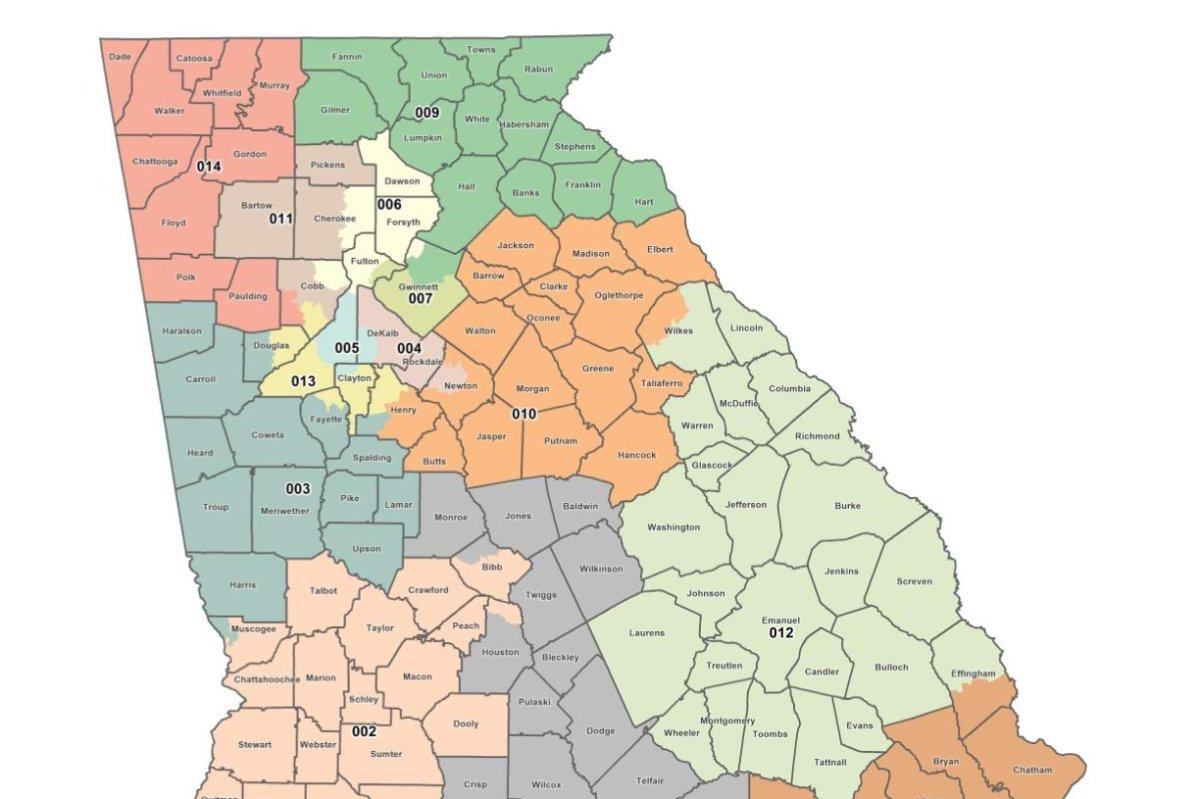
The counties most likely to matter in any new Georgia fight are not random. They are the fast-changing counties where racial growth, suburban voting shifts, and partisan strategy collide: Fulton, DeKalb, Cobb, Gwinnett, Henry, Clayton, Douglas, Newton, and parts of Fayette and Forsyth. Metro Atlanta is the battlefield because that is where Black voters, Latino voters, Asian American voters, younger voters, and college-educated suburban voters have reshaped Georgia politics. Georgia’s earlier litigation focused especially on the Atlanta region, where plaintiffs argued the state should have created another majority-Black congressional district. Ballotpedia notes that the 2021 lawsuit alleged Georgia’s congressional map violated Section 2 and should have created another majority-Black district in the Atlanta region.
If Republicans redraw again, the most obvious partisan goal would be to protect or expand their congressional advantage by reshaping districts around the Atlanta suburbs. In 2023, Republican mapmakers created the required new Black-majority district while also transforming Democratic Rep. Lucy McBath’s district, again forcing her to seek reelection under changed lines. AP described that as preserving the GOP advantage even while complying with the Voting Rights Act remedy. Counties that could benefit Republicans under a new map would likely be those where GOP voters can be packed together more efficiently or where Democratic-leaning voters can be divided among several districts. That means parts of Cobb, Gwinnett, Henry, Douglas, Newton, and Fulton could be rearranged depending on whether lawmakers try to weaken Democratic influence in suburban districts or protect Republican incumbents in nearby exurban and rural seats.
The groups most affected would likely be Black voters in metro Atlanta, Latino and Asian American voters in Gwinnett and surrounding suburbs, younger voters, and suburban communities whose political influence depends on whether they are kept together or split apart. Redistricting can affect voters without changing a single polling place. It changes who counts with whom. That sounds dry until your neighborhood gets sliced into three districts like a gas station pizza. Then suddenly “district geometry” gets personal.
The timing is not mysterious. The 2026 midterms are approaching, control of Congress is narrow, and redistricting has become a national partisan weapon. Reuters reported that the Callais ruling “clears Republican path” to redraw House districts and could open the door for GOP-led legislatures to dismantle majority-Black or Latino districts, though timing may limit immediate 2026 effects in places where primaries are already underway. AP likewise reported that Florida moved quickly after the ruling, approving a congressional map that could significantly increase Republican representation before the midterms. Georgia Republicans have also publicly called for quick action after the ruling, with local reporting noting that some Georgia Republicans want lawmakers to redraw congressional maps ahead of November.
Legally, this moment rests on three major Supreme Court guideposts. First, Thornburg v. Gingles established the basic Section 2 test: a minority group must be large and compact enough to form a district, politically cohesive, and usually defeated by majority bloc voting. Second, Shelby County v. Holder weakened the Voting Rights Act by striking down the Section 4 coverage formula, which made Section 5 preclearance inoperative unless Congress created a new formula. Cornell’s summary states that Section 4’s formula “can no longer be used as a basis for subjecting jurisdictions to preclearance.” Third, Rucho v. Common Cause held that partisan gerrymandering claims are political questions beyond federal court review. SCOTUSblog states the holding plainly: “Partisan gerrymandering claims present political questions beyond the reach of the federal courts.”
Put those together and the legal playing field looks like this: racial vote dilution claims are still legally serious, but Callais makes race-conscious districting harder to defend; partisan gerrymandering is mostly not something federal courts will police after Rucho; and preclearance no longer blocks Georgia maps before they take effect after Shelby County. Translation for diverse learners: the referee left the field, the rulebook got thinner, and both teams are now arguing over the chalk lines.
Historically, both parties have used map drawing for advantage. North Carolina’s Republican-drawn congressional map was central in Rucho, while Maryland’s Democratic-drawn map was challenged in Lamone v. Benisek, which was decided with Rucho. The Court left both types of partisan gerrymandering outside federal court control. Texas is another modern example: Reuters reported that the Supreme Court recently reinstated a Republican-favored Texas map that could shift several House seats toward Republicans in 2026. Georgia’s own 2023 redraw is also an example of a map designed to satisfy a racial-vote-dilution remedy while preserving partisan advantage.
The governor’s race adds another layer, though congressional maps do not directly change statewide votes. Georgia’s 2026 governor’s race is open because Brian Kemp is term-limited. WABE reports that major Republican candidates include Burt Jones, Brad Raffensperger, Chris Carr, and Rick Jackson, while major Democratic candidates include Keisha Lance Bottoms, Michael Thurmond, Geoff Duncan, and Jason Esteves. Redistricting can still matter indirectly because congressional-map fights energize turnout, fundraising, and local organizing. If metro Atlanta voters believe their communities are being split or weakened, Democratic candidates could use that as a mobilizing issue. If Republican voters see redistricting as a legal correction after Callais, GOP candidates could use it to argue for “race-neutral” maps and legislative control. Nobody needs a crystal ball here. They just need a calendar and a campaign consultant with too much coffee.
In county terms, a statewide governor’s race will still be decided by turnout margins across metro Atlanta, the Black Belt, exurban counties, and rural Georgia. Fulton, DeKalb, Clayton, Gwinnett, Cobb, Henry, and Chatham are crucial Democratic vote centers. Cherokee, Forsyth, Hall, Paulding, Walton, and much of North Georgia remain key Republican strength areas. Redistricting does not move those voters out of the state, but it can change political energy and local representation. That is why the same counties keep showing up in these fights. The map may be legal paper, but the real ink is demographic change.
The central factual point is this: Georgia Republicans may see a chance to redraw lines because the Supreme Court has narrowed the legal pressure to create or preserve majority-minority districts under Section 2, while federal courts still generally refuse to judge partisan gerrymandering claims. Civil rights groups argue that this risks diluting Black and minority voting power; Republican supporters argue it restores equal protection and stops race from dominating district design. Both arguments are now part of the legal battlefield.
For students, here is the clean breakdown. Redistricting means redrawing district lines. Gerrymandering means drawing those lines to advantage a group or party. Racial gerrymandering means race was used too heavily in drawing lines. Vote dilution means a group’s voting power is weakened by being split apart or packed together. Section 2 protects minority voters from maps that weaken their ability to elect preferred candidates. Equal Protection limits how much government can sort voters by race. The fight is over where the line sits between protecting minority representation and unlawfully using race.
The final answer is not that one party invented this or one side is innocent. Please. Political parties discovering map manipulation is like teenagers discovering the refrigerator at midnight: predictable, messy, and always denied later. The more accurate conclusion is that the Supreme Court’s redistricting cases have created a legal environment where partisan mapmaking is easier to defend than race-conscious remedial mapmaking. In Georgia, that means counties around metro Atlanta could again become the chessboard, minority voters could face the greatest representational consequences, and the 2026 governor’s race could absorb the issue as a turnout weapon even though the governor’s race itself is statewide.
References
Associated Press. (2023). Judge accepts new Georgia voting districts that benefit GOP.
Associated Press. (2026). Supreme Court ruling on race-based redistricting prompts states to respond.
Ballotpedia. (2026). Redistricting in Georgia ahead of the 2026 elections.
Cornell Legal Information Institute. (2026). Louisiana v. Callais.
SCOTUSblog. (2026). Louisiana v. Callais.
SCOTUSblog. (2019). Rucho v. Common Cause.
U.S. Code. (n.d.). 52 U.S.C. § 10301: Denial or abridgement of right to vote on account of race or color.
WABE. (2026). Georgia’s Primary Drama: Analysts break down the candidates and the chaos.
 The Fair Response
Leave a comment